
Check Windham's Owner of Record
Think of the current owner record as a town-level snapshot built for assessment. Windham's assessor keeps the ownership data and mapping used for tax work. Every other Windham County town maintains its own roll the same way, so the parcel's legal town decides where you look.
| Owner name | Individual, trust, estate, or entity carried on the roll |
|---|---|
| Mailing address | Where the town sends tax correspondence |
| Situs address | The parcel's physical location |
| Parcel or map/lot | The key connecting tax and map systems |
| Last sale date | A sale field, not necessarily the refresh date |
| Deed reference | Book/page or instrument clue for the recorded document |
The official Windham Assessor page is the starting point for Windham town parcels.
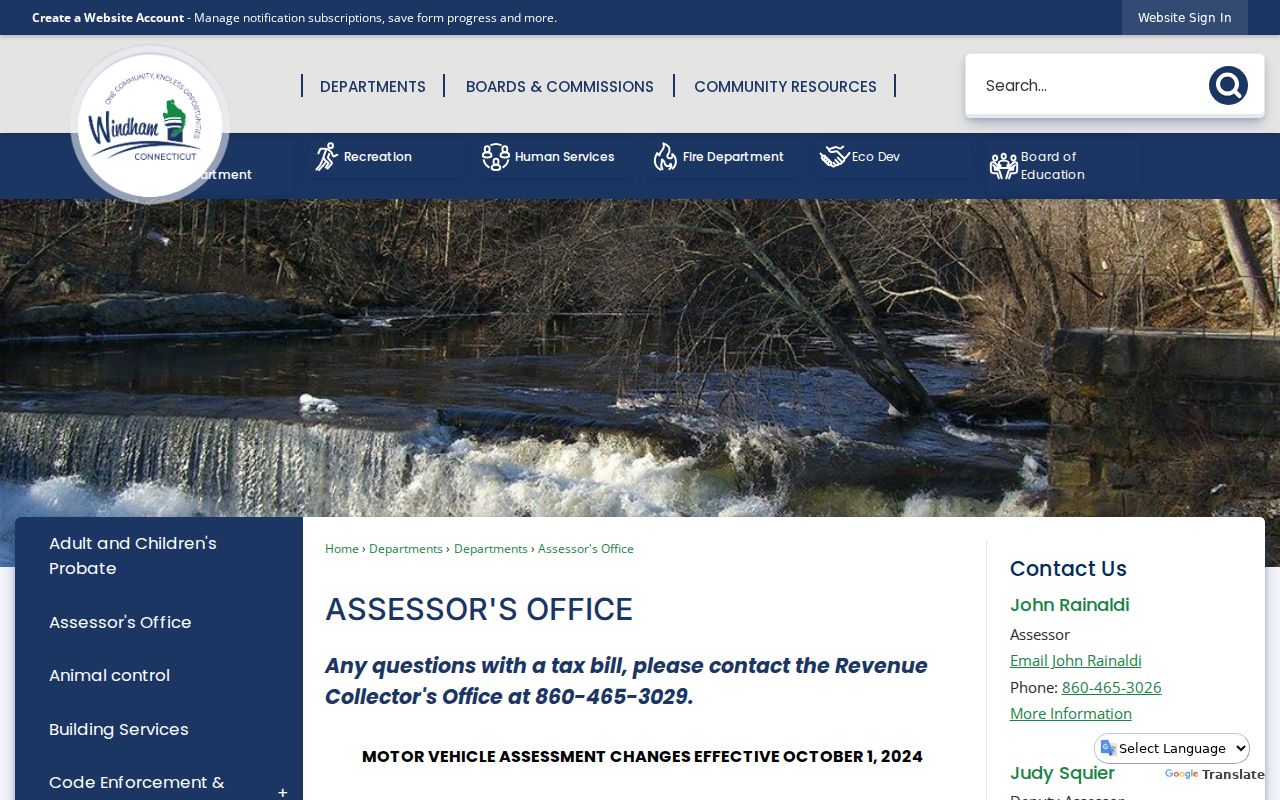
The office page links the local tools for parcels inside Windham. Property in any other town requires that town's own assessor.
Confirm Windham's Current Owner
Take the displayed current owner and parcel reference, then hunt for the newest recorded deed. Windham SearchIQS carries indexed images from November 24, 1965 forward. Other Windham County towns may rely on a different portal or an in-office route instead.
- Confirm the legal town and open its current assessor card.
- Copy owner spelling, parcel ID, situs, mailing, sale date, and deed reference.
- Search the town clerk's latest deed by grantee and instrument reference.
- Compare the grantee, legal description, and recording timestamp with the roll.
- Owner of record
- The party carried as owner in the record consulted.
- Assessment roll
- The town's tax list of parcels, owners, and values.
- Recording lag
- Time between deed filing and a later system update.
Time Windham Owner Updates
No countywide refresh cycle exists, because fifteen towns each run separate systems. Never assume a fixed lag. Record the card date, deed date, and recording timestamp separately. Windham's 2023 revaluation adjusted value, not ownership. So it cannot tell you when the current owner acquired the parcel.
Recent sale. The roll can lag a closing. The newest matching recorded deed is the more current public recorded evidence.
Read Windham Trust Owner Names
The owner field may hold a trustee, executor, administrator, conservator, estate, corporation, or LLC. Keep those capacity words with the name. For a business, run the Connecticut business search. But a registered-agent address is not the parcel situs. Trust beneficiaries may stay out of public view.
When online tools come up short, ask the town assessor for a printed card. The clerk can provide in-office indexes, deed books, recorded maps, copies, or certification. Give the town, party, date, parcel, and instrument reference to speed the request.
Respect Windham Owner Privacy
The tax mailing address may not match the property. Connecticut Safe at Home can supply a substitute address for qualifying people. Do not try to reverse-engineer missing or protected data, and keep any public mailing route tied to lawful property matters.
Lawful use. Current owner records may support purchase, boundary, estate, or civic research. Never use them to stalk, harass, or harm anyone.
Reaching an owner is not proof of possession or consent. The mailing address may belong to an accountant, trustee, attorney, registered agent, or another designated recipient. Keep communication tied to the property issue, and use the public channel exactly as published.
Choose the Current Windham Town
The legal municipality decides which owner roll to open. Windham County comprises Ashford, Brooklyn, Canterbury, Chaplin, Eastford, Hampton, Killingly, Plainfield, Pomfret, Putnam, Scotland, Sterling, Thompson, Windham, and Woodstock. No county office merges those owner fields.
Postal geography misleads. Willimantic sits inside Windham, while Danielson sits inside Killingly. Dayville, Ballouville, Moosup, Central Village, Wauregan, and other place names can appear in addresses. None of them shifts town custody. Confirm the town and parcel in GIS, then use that town's assessor and clerk. A statewide parcel layer can help discover a crosswalk. However, voluntary town submissions and suppression rules keep it from replacing local property records.
If an address search fails, try the parcel number or the GIS map and lot. Field labels vary across vendors, so do not assume exact matches. Windham exposes no text-searchable VGSI interface, and Killingly uses AxisGIS. When a vendor search rejects the address form, the assessor office can identify the right card.
Compare Windham Deed Timestamps
A deed carries an execution date and a recording timestamp. Parties often sign well before the clerk records the instrument. Recording order controls for current owner research. The public land record is organized around filed instruments. Search later dates too, not just the closing date another source supplies.
Windham SearchIQS offers indexed images from November 24, 1965 forward. Its fields cover party, date, description, book and page, instrument, and case. Search the exact roll name first, then variants. If the owner is an entity, preserve punctuation and suffixes. Also try a normalized version. Read the deed image itself, not just the OCR or index summary.
The deed's legal description should tie back to the current parcel. A map reference, lot number, condominium unit, metes-and-bounds tract, or parent parcel can help. These details often explain an address match that seems incomplete. GIS adds discovery context. It does not prove ownership of every acre. The person named on a tax card may not own the whole drawn polygon.
Corroborate a Windham Current Owner
A tax account can support a current owner finding. It does not replace the deed. Windham's Revenue Office and town tax systems may list the billed name, property number, street, year, bill number, and account identifiers. Payment status answers a tax question, not title.
For an LLC or corporation, Connecticut business records can show the formal name, status, agent, principals, filings, and name history. That resolves abbreviations or a renamed business. It does not prove an officer owns the parcel personally. For a trust or estate, the land record may disclose only a trustee or fiduciary capacity.
Keep a short evidence log. List the legal town, parcel ID, assessor owner and card date, deed grantee and recording date, legal-description match, and any unresolved discrepancy. An auditable trail keeps a newer current owner record from mixing with an older sale or tax entry.
Windham's free property-fraud alert adds monitoring, not ownership proof. The service emails when a potentially relevant document is filed under an enrolled name. It cannot prevent a filing. When an alert arrives, inspect the clerk's recorded image and verify the parcel and parties. The alert alone proves no fraud.
Account data can lag or carry a tax-specific name. Windham and Willimantic taxing districts shape bill context inside one town, but they do not create separate title custody. Killingly's Danielson borough line offers a similar tax clue. A district label helps identify the right account, though the deed remains the recorded transfer evidence.
Where a current owner field looks deliberately limited, respect Connecticut privacy rules: state parcel and CAMA submissions may suppress protected information under CGS §1-217. Safe at Home can provide a substitute address. Neither situation justifies using unrelated databases to reconstruct a protected location.
Resolve Windham Owner Discrepancies
A roll-to-deed mismatch starts with one question: do both records describe the same parcel? Compare situs, parcel ID, map and lot, legal description, and any prior deed reference. A street address can cover several parcels. A current tax parcel may also result from a split or merger the older deed described as a larger tract.
Next, compare dates. The deed execution date, recording timestamp, assessor card update, last sale field, and grand-list year are separate facts. A 2023 revaluation changes the base, not the owner. A tax payment date likewise shows no transfer. State each date with its source.
Then check how the grantee is named. A trust, estate, executor, administrator, trustee, conservator, corporation, or LLC may be abbreviated on the assessment card. Search both the exact recorded form and a normalized version. Connecticut business data can clarify an entity name change. Probate files may explain a fiduciary capacity, though the recorded fiduciary deed remains the land-record link.
Finally, ask the two custodians. The assessor explains the owner field and roll timing. The town clerk can verify the newest recorded instrument and supply a certified copy. Never treat an online index summary as the full deed; record the missing image and request it by book/page or instrument number.
A discrepancy may reflect ordinary update lag. It can also signal the wrong parcel, an incomplete legal description, or a different ownership interest. Keep the finding qualified until the sources align. Competing claims or unrecorded rights go beyond a current owner lookup and warrant professional title review.
Document Windham Current Ownership
Save enough context for someone else to repeat the check. Record the legal town, portal or office, access date, parcel ID, displayed owner, mailing and situs fields, assessor date, deed grantee, recording timestamp, document type, and instrument reference. Note whether the deed image was reviewed. That keeps a name copied today from being presented later as timeless.
In Windham town, the clerk's data table separates modern indexed images from historical books. The present-owner task normally stays in the current index. The prior reference can confirm parcel continuity. Other towns set different online cutoffs, and an office search remains available when the web portal is missing, blocked, or incomplete.