
Run a Windham County Property Search in Five Passes
Work in five passes: address, parcel, owner, recorded documents, and bill status. Windham County has no countywide assessor. Each town runs its own assessor and GIS systems, with Windham, Killingly, and Plainfield keeping separate databases. Pick the town before you type a name.
- Resolve the town from an official address, deed, or town map.
- Search its assessor by situs and copy the parcel or account ID.
- Compare the selected GIS polygon and adjacent road labels.
- Search the town clerk's index under the displayed owner and likely seller.
- Check the tax account, then request any needed clerk or assessor copy.
Town Identity Comes Before Windham County Property Search Fields
Windham County covers fifteen towns: Ashford, Brooklyn, Canterbury, Chaplin, Eastford, Hampton, Killingly, Plainfield, Pomfret, Putnam, Scotland, Sterling, Thompson, Windham, and Woodstock. A village name creates no new recorder. Willimantic papers file in Windham. Danielson and Dayville file in Killingly. Moosup and Central Village file in Plainfield.
If the legal town is unclear, check the address against the town GIS map and the USPS address lookup. Once you have a town parcel number, write it down exactly as displayed. Assessor, map, tax, and clerk systems may label the same parcel differently, so resist the urge to reformat the number in your notes.
Windham Assessor Search Modes Start the Lookup
The Windham Assessor page anchors every town lookup. It is the official entry for assessment and mapping tools.
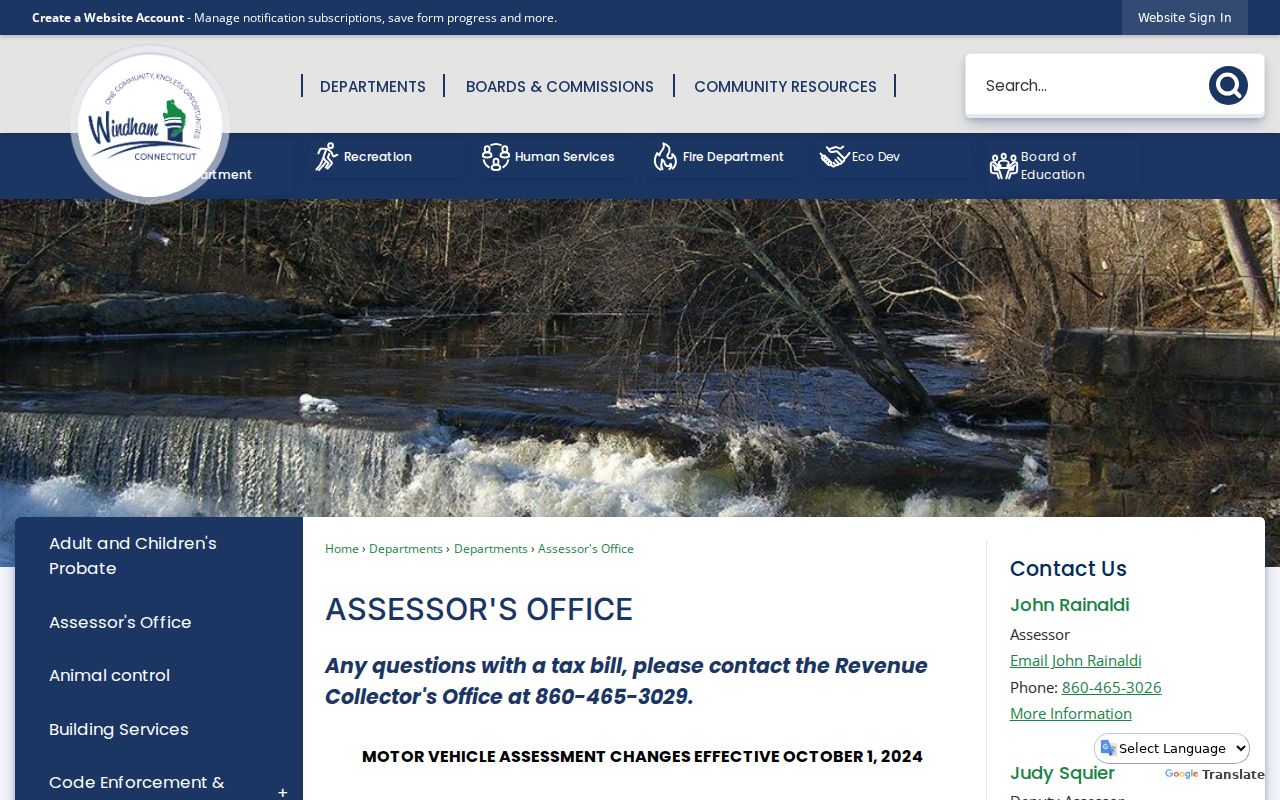
That Windham Assessor page leads to public assessment and map tools. The office maintains the ownership records and parcel mapping. Search modes cover owner name, situs address, parcel or account number, map and lot, and recent sales. Field labels can change as the vendor updates the site. Try more than one mode. A name alone is rarely the fastest route.
| Likely key | How to use it | Check in the result |
|---|---|---|
| Situs address | Street number and name | Correct town and parcel |
| Owner name | Surname, entity, or trust variant | Displayed owner field |
| Parcel/account ID | Exact identifier from map or bill | Map and assessment match |
| Map/lot | Use local punctuation and format | Legal-description crosswalk |
Widen the search if suffixes suppress a match, and never substitute a mailing address for the situs address.
Read the Windham County Property Search Result as a Snapshot
One parcel card can hold plenty. It gathers identification, ownership, assessment, sale, and building details, though exact labels vary by town and vendor. Copy the parcel fields before interpreting value or ownership.
| Owner display | Assessment owner as of the card update |
|---|---|
| Situs and mailing | Land location versus notice destination |
| Parcel/account ID | Town key used across map and tax tools |
| Land, improvement, total | Components and assessment year |
| Legal or map reference | Clue leading to deed or recorded map |
| Sale history | Date, amount, and any displayed reference |
The card does not prove current title. Nor does it confirm occupancy, boundaries, or price. A freshly recorded deed can predate the assessor's update, and exemptions can shift taxable treatment without ever touching title.
SearchIQS Adds Party, Date, and Document Keys
Windham's SearchIQS land-record entry supports guest searches. An Index Books tab covers older volumes. Party 1, Party 2, an optional date range, document group and description, book and page, instrument number, and case number all work as keys. Enter names last name first. A wildcard can test partial spellings.
Start broad and narrow later. Search both party positions, then filter by date or document type, since a blank ending date runs through the present. Town fields offer no guarantee, because some instruments are not indexed to a town. Open the image and compare the legal description and the prior-instrument references.
Older Windham Property Searches Switch to Books
Modern indexed Windham land records start on November 24, 1965. Index books cover 1706 through 1977. Listed book images reach back to August 3, 1687. The overlap bridges old and new chains. Still, image access is not a modern index. Open the Index Books tab, pick a volume, and search a surname. Jot down book and page. The document view shows the deed itself, so watch for alternate spellings and fiduciary roles. If a book shows no image, consult the Windham Town Clerk's films and indexes. Do not assume the deed never existed.
Tax Search Fields Can Confirm the Same Parcel
Killingly's MyTaxBill portal shows a town tax search done right. It accepts many identifiers. Name, property address, bill details, account number, Tax ID, Account ID, and DBA all work, and filters separate all accounts, current amounts, balances due, and an IRS payment-record view. Name format is strict. Type last name, a space, first initial, and skip the comma, while the address wants the property number and street name with common street-type abbreviations.
Results can include real estate, personal property, vehicles, district bills, and sewer charges. Confirm the bill type and parcel identity. A tax match corroborates a search but does not prove title.
Recent Deeds Can Lead the Assessor Card
Windham publishes no average for the lag between recording and an ownership-card update. Treat the displayed owner accordingly. The card reflects its stated date only. For a recent sale, line up the newest deed's recording timestamp, the card update or assessment year, and the tax mailing name.
Note: A post-closing mismatch may simply reflect update timing, but confirm it directly with the town custodian before relying on either date.
The clerk controls deed chronology. The assessor keeps the tax-administration record, so preserve both dates and a later reader can see why the names differed.
Entity, Trust, and Same-Name Searches Need Variants
An owner of record may show up as an LLC, a trustee, an estate, or another entity rather than a person. Run the name exactly as the card displays it. Then test punctuation, abbreviations, and the signer or fiduciary capacity named on the deed. Connecticut business filings can clarify an entity's legal name and who signs for it, but a filing alone never proves that entity holds the parcel.
Common personal names need guardrails. Pair the party with a date range, a legal description, a prior instrument, and a parcel reference so the deed records cannot mislead you. Old road names and renumbered streets can defeat an address-only query, so bridge the gap with a book and page reference, a historic directory, a town map, or the clerk's own index.
Use Every Documented Access Channel When a Portal Stops
When a portal stalls, a Windham County property search can still continue. Use the town office that holds the record. Town clerks offer counter access to land records, maps, index books, films, and copies. Windham itself points searchers to office searches and to pre-1966 films or index books. Assessors and collectors can explain parcel IDs, card dates, district fields, and account status. Ask whenever a public interface returns an unclear match.
Frame each request around the record itself. Give the legal town, the situs address, the owner or entity spelling, a date range, and the parcel ID. Add any instrument or book and page reference. Ask about in-person inspection, mail or email copies, certification, and the current charge before ordering. Connecticut FOIA requests also go to the agency holding the record. Ordinary copy limits plus statutory land-record fees apply under separate rules.
Historical address problems call for a different fallback. The Connecticut State Library may hold town reports, directories, newspapers, road maps, probate material, or photographs. Local libraries and historical societies may hold them too. Catalog access sometimes requires an account, an affiliate library, an appointment, or a reading-room visit. Record the gap honestly instead of forcing an uncertain match into your deed research.
Windham County Parcel IDs Are Crosswalks, Not Old Titles
A modern parcel number earns its keep in one town. It links assessor, GIS map, and tax roll results together. It can also point toward a map or a legal-description clue. It is not a colonial-era identifier, however. A split, merger, lot-line revision, or vendor conversion can change it entirely.
When the number changes, keep both versions and the dates each appeared. Follow the current deed's prior-instrument reference. Compare map and lot data, and read the legal description closely. For renamed roads or old Willimantic labels, add historic maps, directories, or clerk books to the mix. The goal is a documented crosswalk. Matching street text never proves the same tract.
Choose the Best Windham County Property Search Key
Each key answers a different first question. An address is fastest when you know the place. Owner name suits indexed party work in the deed records. Parcel number is the strongest crosswalk once the property itself is pinned down.
| Search Key | Best For | Where It Works | Watch Out |
|---|---|---|---|
| Address | One known property | Assessor, GIS, tax | Postal town or renamed road |
| Owner name | Assessment and deed-party matches | Assessor and clerk | Entities, trusts, same names |
| Parcel number | Exact local crosswalk | Map, assessor, tax | Format changes between systems |
Not a title search. A Windham County property search gathers public evidence but does not guarantee clear title or establish a surveyed boundary.
Keep a search worksheet when several town systems come into play. The first row should name the legal municipality, not just the postal place. Then log the situs and the owner spelling as displayed. Add the mailing address, the parcel or account number, and the map and lot. Record the assessment date, the deed instrument, and the book and page. Finish with the tax account and the source date. If Windham County property search results disagree, preserve both entries. Do not overwrite the older one. The difference may expose a recording-to-assessment lag. It may also reveal a parcel split, a renamed road, a trust capacity, or a plain wrong-town search.
Treat a no-result screen as a prompt for a controlled retry. Strip punctuation. Test a surname or entity variant. Shorten the street name, and enter a known parcel identifier exactly as the town displays it. For deeds, switch the party positions and widen the recording dates. For historical land, move from current fields to the index books and book images. If those steps still fail, contact the town clerk or assessor with the exact query. Ask about counter, mail, email, film, or vault access.
Save enough retrieval data that another person could repeat the Windham County property search from scratch. A screenshot alone may omit the town, the date, or the record chosen. Pair it with the portal URL, the date viewed, the query type, the result identifier, and any image or copy reference. When wording or recording status matters, order certified copies from the custodian. That discipline turns scattered public lookups into a documented trail. It does so without mistaking an assessor result for a title report.