
Identify a Windham County Owner
Pinpoint the legal town first. Windham County has 15 legal towns. None answers to a county recorder or county assessor. Willimantic sits inside the Town of Windham, and Danielson is a borough of Killingly. A ZIP code or village label will not identify the custodian. Once the town is settled, use its own assessor, GIS, clerk, and tax systems.
- Confirm the legal town, then search its assessor by the physical, or situs, address.
- Copy the parcel ID and displayed owner of record. Use GIS to confirm the parcel location.
- Search the town clerk's index for the newest deed naming that owner as grantee.
- If an LLC owns the parcel, check the Connecticut business search, without treating its agent address as the parcel address.
Windham owners can start with the Windham Assessor. The clerk's SearchIQS records carry the deeds. Other towns require their own portal or office, and wherever you search, keep the owner spelling, recording date, instrument reference, and legal description together in one note.
Compare Windham Ownership Sources
No single screen settles every Windham County owner question. Each source does one job. The town tax roll is fast, the deed is recorded evidence, the GIS map supplies location context, and a state business record decodes an entity owner, all with different dates and purposes.
| Source | Owner Info It Gives | Access |
|---|---|---|
| Town assessor roll | Displayed owner, mailing and situs fields, parcel and values | Town portal, phone, office, or printed card |
| Town clerk deed index | Latest grantee, deed date, book/page or instrument | Online where offered, office books, or copy request |
| Town GIS | Parcel polygon, identifier, address, and available links | Town viewer or mapping office |
| Secretary of the State | Entity name, agent, principals, and filings as available | State search and public datasets |
The owner field, the situs, and the mailing address can all differ. A nonlocal mailing address does not mean a sale. Someone at the situs is not always the owner. A recent deed can also postdate the assessment roll. The official Windham Assessor page is the source-linked starting point for a Windham town owner lookup.
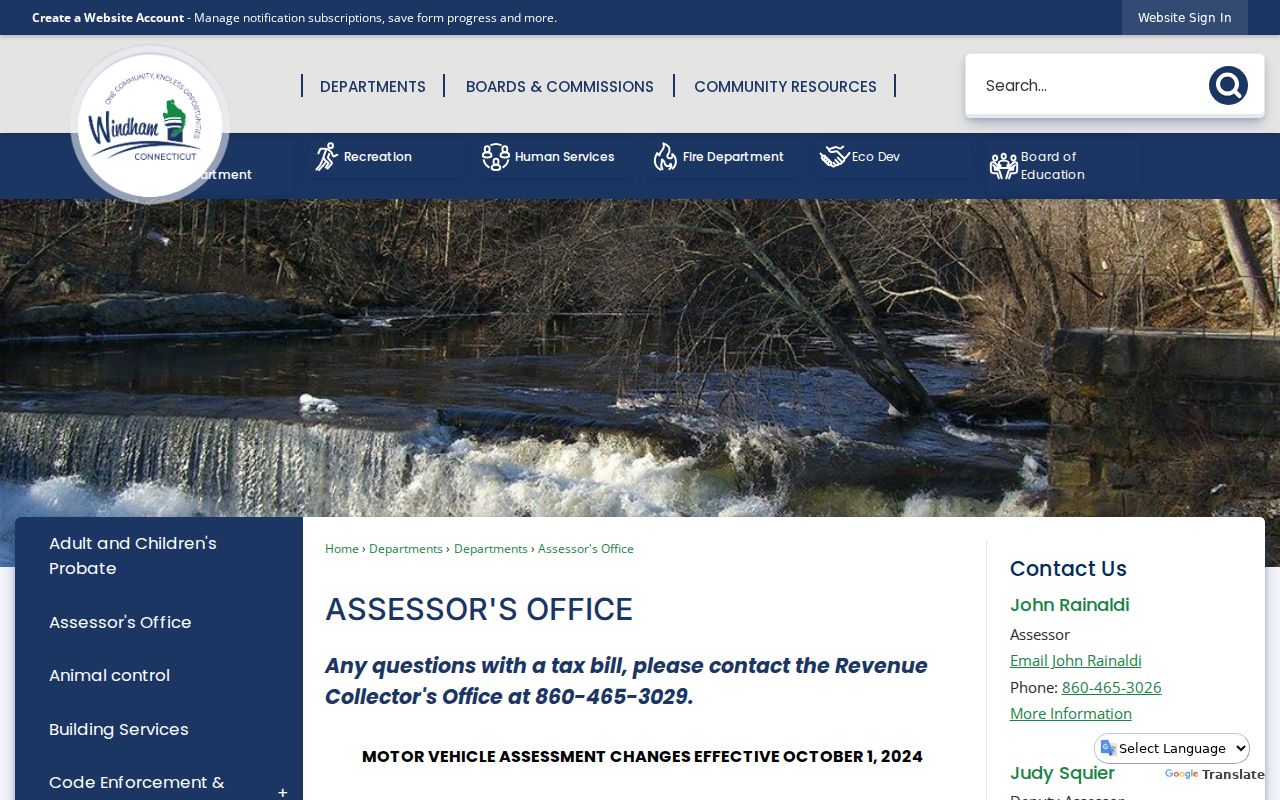
The image shows the local assessor route for one town. Windham County has no countywide owner system, so a parcel in another town goes through that town's own assessor.
Crosswalk Windham Owner Records
The parcel ID is the safest bridge between records. It ties the address, assessor card, tax account, GIS shape, and deed description together. Street names change. Owner names may carry initials, former surnames, corporate suffixes, or fiduciary roles. Matching on the parcel key cuts through those variants, though the systems do not all update on one schedule. Online access is only one route. A town assessor can answer by phone. Town clerks keep deed books, recorded maps, copies, and certification. Focused mail or email requests should include the town, party, date, parcel, and book or instrument reference. Older Windham County records also sit at the Connecticut State Library and on FamilySearch.
Decode Windham Entity Owners
An LLC, corporation, trust, estate, or fiduciary can appear as owner of record. Search the exact name and its common abbreviations. Connecticut business data can show status, agent, principals, filings, and name history. Those records corroborate identity. A registered-agent office, though, does not prove where the parcel lies. Trusts rarely publish beneficiaries. Estate transfers may use executor, administrator, or trustee language. Match the legal description and deed reference rather than a surname alone, and for anything deeper, the focused current owner record explains the present roll-and-deed check, while prior ownership requires a backward deed chain.
- Owner of record
- The party shown in the current official record consulted.
- Grantee
- The party receiving an interest in a deed.
- Title
- Legal ownership rights, requiring more analysis than a roll lookup.
- Situs address
- The physical parcel address, not the tax mailing address.
Willimantic Owners Use Windham Records
Willimantic consolidated with Windham in 1983. A city-era deed or directory may still say Willimantic. The modern owner lookup, however, belongs in Windham town systems, so pair the old label with the current parcel ID and search both historic and current name forms. This clue often rescues a failed search. There is no separate Willimantic recorder; the Windham Town Clerk remains the land-record custodian.
Limits of Windham Owner Lookups
A “who owns this property” result will not name every occupant or beneficial interest. The owner may be a trust or an entity. It also cannot establish clear title, settle a boundary, interpret an easement, or prove a recent deal is final, so compare the dates and read the recorded deed image. Connecticut's Safe at Home program gives qualifying participants a substitute address. Suppressed data is not an error. Respect the suppression and ask about lawful access.
Use records lawfully. An assessor name is not proof of title, and public data must never be used to stalk, harass, or harm someone.
Tax records can corroborate a name, mailing address, or account, but they are not the transfer instrument. A tax bill may keep an older mailing contact or show a district name. Windham and Willimantic taxing districts add local context without creating separate ownership systems. The town clerk's deed remains the anchor. Write timing down; do not guess it. Save the assessor card date, last sale date, deed execution date, and recording date. Those dates answer different questions. A roll can be right for its cycle yet trail a deed filed after the last update. No single lag applies across all 15 towns. When deed and roll disagree, recheck the legal town, parcel ID, and legal description. Was there a split, a merger, a condominium unit, a trust capacity, an estate transfer, or a name change? Ask the assessor about the card. Ask the clerk too. Never force a match from records describing different tracts.
Test Windham Owner Evidence
A solid owner finding rests on two official sources that agree. The assessor card links a name to the parcel that gets taxed. The newest recorded deed ties a grantee to the legal description. Check that the parcel ID, map and lot, situs, and prior deed reference line up. When they do, both records plainly describe the same Windham County land.
SearchIQS itself cautions users to read original documents instead of trusting OCR. That warning counts for a lot. Initials get dropped. Corporate names get mangled. Acreage gets garbled, and covenant terms suffer worst of all. An index is only a finding aid. The signed recorded image carries the operative words. If an image will not open, request the town clerk's copy. Note that the online result was index-only.
Some ownership questions exceed what a public lookup can settle. Competing deeds are one example. So are unrecorded agreements, inheritance rights, adverse possession claims, and boundary disputes. Those issues can call for a title examination and legal advice. An official-source method improves accuracy. But it never turns a property records search into a title opinion.
The town tax collector adds one more administrative check, stamped with a date. Search by whatever fields the town publishes. These may include a name, street, property number, bill year, bill number, or account identifier. Read the results with care. A paid bill does not prove ownership, and a balance does not prove a transfer. Use tax data only to confirm one thing. The same parcel and billed party appear in the town's current system.
For property-fraud concerns in Windham town, SearchIQS offers a free alert. It can email a notice whenever a document is filed under an enrolled name. It cannot block the filing. It also cannot judge whether a document is fraudulent. Verify any alert against the recorded image, then contact the clerk. Monitoring helps a current owner stay informed, but it sits outside the proof chain.
A well-supported answer to who owns a Windham County property names the town first. It then lists the assessor source and date. It lists the latest deed reference with its recording date, and any entity or trust capacity. It also discloses mismatches or a missing image. That compact record beats copying a bare name from a portal. It beats a name with no parcel and no date.
Resolve a Windham Owner Match
Same-name results call for a small evidence worksheet. Start with the assessor roll. Write down the exact owner string, the situs, the mailing address, parcel ID, map and lot, legal description, and sale date. Also record the deed reference. Then record the latest deed's grantor, grantee, recording timestamp, document type, and prior reference. The answer holds up only when those details describe one tract.
Name variants are normal in Windham County deed records. Search a surname with and without a middle initial. Preserve former names, marital capacity, trustee wording, estate roles, and corporate suffixes. SearchIQS supports broad party and date searches, plus document, book/page, instrument, and case fields. Loosening the criteria can surface an entry hidden by a spelling difference. Narrow the search only after reviewing the broader results.
Never confuse a mortgage party with the owner of record. A borrower often appears as grantor in a mortgage index entry. The lender appears as grantee there. The ownership deed carries its own grantor and grantee. Releases, assignments, liens, easements, and declarations also affect property without transferring it. Read the document type and the actual image before deciding who owns the land.
A recent deed can name more than one grantee. It can also convey only part of a parcel. Compare the interest conveyed, not just the names. Condominium units and common elements need unit and declaration references. A fiduciary deed can transfer property out of an estate. A quitclaim passes the grantor's stated interest but promises nothing about clear title.
If the answer stays murky, take the parcel ID and deed reference with you. Bring them to the town assessor and clerk. Ask whether the roll has updated. Ask whether a newer instrument exists. State the discrepancy plainly without picking a preferred answer. Formal questions about competing claims, unrecorded interests, or ownership rights belong with a title professional or lawyer. Those are not for a broader people search.
Route Windham Ownership Requests
Every access channel has its role in a Windham County property search. The assessor portal or office finds the parcel card. GIS confirms the mapped location. The clerk's online index, office books, and certified-copy service supply the recorded instruments. A mailed or emailed request works best once you supply the town, party, date, parcel, and instrument reference. The tax collector can corroborate the current account, while planning and building offices hold permit files tied to the address.
Historical ownership may call for deeper sources. Clerk films and index books help, along with FamilySearch, the Connecticut State Library, or a local research library. Those sources track old names and old streets. They still do not outrank a matching recorded transfer. When an agency record is public but not routinely posted, Connecticut FOIA opens an inspection or copy route, subject to the records that exist and lawful exemptions.