
Build a Windham County Property Records Search
Jurisdiction comes first. Connecticut dissolved county government in 1960, so the fifteen towns in this corner of the state each run their own land, assessment, tax, and map systems. Pick your starting office by what you already know. With an address, begin at the assessor. With a party name or a book and page, go to the clerk. Need a parcel number or map context? Start with GIS.
Each source has its own job. The assessor card is a tax snapshot, the tax account shows bills and balances, and GIS maps the geometry. For a conveyance, the recorded instrument is the key source. None of these stands in for a professional title examination or a boundary survey.
- Confirm the legal town from the address, deed, or town GIS.
- Search the town assessor by situs address and copy the parcel ID.
- Use the owner's name in the correct town clerk's land index.
- Compare the tax account and town parcel map with the deed.
- Ask the custodian for an office search or copy when the web record ends.
Where Windham County Property Records Actually Live
Windham County has no clerk, recorder, assessor, or treasurer today. Every town clerk records the deeds, mortgages, releases, easements, and maps. Every town assessor keeps the parcel and valuation data. Each tax collector keeps the bills and payment accounts. The Town of Windham offers the best online example. Its systems say nothing about Killingly, Plainfield, or the other towns. Each municipality answers only for itself.
Windham Assessor
Town-level parcel records
Windham, Connecticut
See town contact page
Windham Revenue Office
Town tax accounts
Windham and Willimantic districts
860-465-3029
Fifteen Town Systems Define Windham County Property Records
Windham County has fifteen towns. These are Ashford, Brooklyn, Canterbury, Chaplin, Eastford, Hampton, Killingly, Plainfield, Pomfret, Putnam, Scotland, Sterling, Thompson, Windham, and Woodstock. Stay inside the correct town. Danielson and Dayville belong to Killingly. Moosup and Central Village belong to Plainfield. Willimantic belongs to Windham.
That split also explains why no countywide property portal exists. The town can be uncertain at times. Confirm the municipality through an official address source and the town parcel map before searching names. A ZIP code can cross local labels and should never replace the legal town.
Windham County Deed Images Span Three Search Eras
Windham's SearchIQS availability table splits modern index data from historical image access. Land records from November 24, 1965 forward carry both. Index data and images match across that span. Grantor and grantee index books cover 1706 through 1977. Listed record-book images run from August 3, 1687 through December 31, 1965.
Note: An old deed image appearing online does not mean a modern address or full-name search can reach it.
For older material, search by volume, name, or book and page, then review the image. A missing volume or a "no images" result marks a limit of availability, not proof that no instrument exists.
Which Windham County Property Records Answer Each Question
Property research stalls when one source is asked to do another's job. A deed documents a transfer. An assessment card organizes tax facts. A parcel map locates mapped land. Court, probate, and permit files may explain events that the basic card never shows.
| Record Type | What It Documents | Kept By | Access |
|---|---|---|---|
| Deeds | Transfers, parties, legal descriptions | Town clerk | Town portal or office |
| Mortgages and liens | Recorded claims, releases, and notices | Town clerk | Index, images, or clerk request |
| Assessment and tax | Owner display, value, exemptions, bills | Town assessor and collector | Town system or office |
| Plats and parcels | Lot references and mapped geometry | Town clerk and GIS | Recorded map and viewer |
| Permits | Applications, reviews, inspections | Town departments | Portal or department request |
Use the Windham County deed records guide when the question is title chronology. For boundaries, compare the recorded map and legal description with GIS rather than treating a tax map line as conclusive.
Windham Assessor Cards and Deeds Serve Different Roles
The Windham Assessor maintains ownership and mapping for roughly 7,000 real-estate parcels. The office completed a revaluation dated October 1, 2023. A parcel card can show the owner, mailing address, situs, parcel ID, land and improvement values, sale facts, and exemptions. Many cards also carry a GIS link. Read exact public labels from the live card.
The displayed owner does not always update the moment a closing is recorded. Compare a recent card with the newest town-clerk deed and check both dates. The mailing address is where notices go, while situs is the land's location. Neither one proves occupancy.
Tax District Lines Add a Windham County Property Records Clue
Windham's revenue material separates the Windham and Willimantic taxing districts. Killingly's collector system adds Danielson borough context. Those district lines help confirm a bill belongs to the intended parcel. A bill still does not establish title.
Rates and due dates change often. Read them on the relevant town collector's page. Note the bill year, account, district, balance, and posting date. Online payment status can lag. Keep your confirmation and verify time-sensitive balances with the collector.
Windham County Property Records in GIS Need a Town Check
Windham links AxisGIS and VGSI. Killingly links its own AxisGIS. Plainfield references VGSI in revaluation material, so no single county parcel viewer covers them all. Search by situs or parcel ID, then identify the polygon. Record the adjoining parcel IDs. Then return to the assessor and clerk.
Map layers for zoning, wetlands, flood areas, aerial imagery, or planned districts are research aids. Windham's named PDD districts and Killingly's planning categories can point toward approvals. Still, layer dates and disclaimers matter. A recorded plat and a licensed survey carry a different evidentiary weight.
Willimantic Names Lead Back to Windham Town Records
Willimantic spent ninety years as its own city. It incorporated in 1893 and consolidated with the Town of Windham on July 1, 1983. Old deeds, directories, and plat maps still carry the city name. A Windham County property records search may hit dead ends if the label is treated as current. For live land and assessment lookups, the Town of Windham holds the parcel data. That is why place-name history matters in any property search.
North Windham, Windham Center, South Windham, and Willimantic describe distinct geographies within one town. Old mill lots, rail corridors, and planned districts may appear only on historic maps. Some survive only in planning files. A modern parcel number helps, but sometimes the old vocabulary is the only way in.
Permits Add Address-Keyed Evidence to Windham County Property Records
Windham PermitLink groups routes for Building Services, Public Works, Zoning, Wetlands, the Board of Health, the Fair office, and the Clerk. Guest access shows department information. Permit actions and documents require an account or PIN.
A permit ties an address to an applicant, a project, reviews, inspections, and attachments. It proves nothing about title. Killingly points the public to its permitting and planning staff, and Plainfield's guide separates planning, zoning, wetlands, building, and clerk filings into distinct steps. When nothing surfaces online, call the department with the exact address and project type.
Courts and Probate Explain Some Property Changes
The Windham Judicial District of the Connecticut Judicial Branch serves all fifteen towns. Foreclosure, quiet-title, partition, and lien-enforcement cases add docket context to a deed history. The online inquiry is not the official court file, though. Get pleadings or orders from the clerk, and ask about sealed or protected material first.
Estate transfers often pair a probate order with fiduciary authority and a recorded executor, administrator, trustee, or conservator deed. Probate district lines moved over the years. Older files may sit with a historic district, an archive, or microfilm. Search capacity terms, not just names.
Historic Windham County Property Records Go Beyond the Web Index
Historic Windham County property records survive far beyond the web index. The Connecticut State Library, town libraries, and historical societies hold sources. These connect old names to modern parcels. State Library guides point to town reports, judicial papers, directories, newspapers, photographs, and road or railroad maps. FamilySearch catalogs list Brooklyn probate, Plainfield probate, and Putnam land volumes.
Access can require an account, an affiliate library, a reading-room visit, or an advance request. Ask a town clerk for a volume and page instead of a broad county search. Willimantic Public Library and historical groups in Windham, Killingly, and Putnam can help. They can identify directories, newspapers, and place-name changes. Confirm exact holdings before relying on any single collection.
A Free Filing Alert Is Monitoring, Not Prevention
The official Windham Town Clerk page confirms the land-record custodian and contact route.
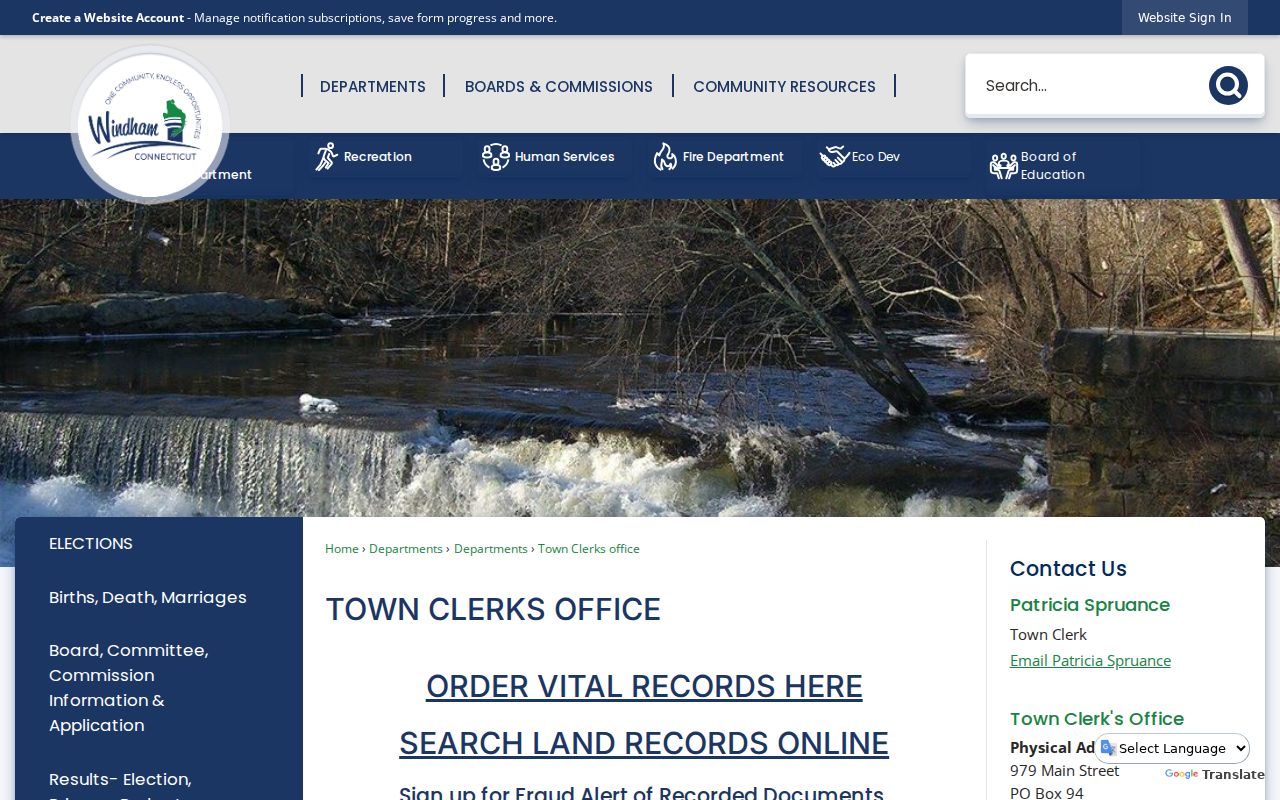
The town's official clerk page displays the fraud-alert enrollment link. Visit it before any trip to the search portal. Windham's Town Clerk posts a free SearchIQS property-fraud alert there.
Enrollment sends a notice when a document indexed to a chosen name is filed. It is monitoring, not prevention. The service cannot reject, validate, or stop an instrument. Name matching can flag false positives or miss variants. Read each alert promptly. Open the indexed image when one exists, and reach the clerk through an official channel if the filing looks unfamiliar. The clerk also warns that OCR text is only a search aid; the signed town copy controls.
Town Offices Provide the Essential Offline Record Route
A stalled online session does not end a Windham County property records search. The town clerk keeps vault indexes, films, maps, plain copies, and certified copies. The assessor can explain parcel fields and the update date. The collector confirms balances and payment postings. Planning, zoning, building, and wetlands staff hold address-keyed permit material that no land index contains.
Keep the request focused. Give the legal town, the street address, the record type, party names, and an approximate date. Include any parcel, instrument, book, page, map, or application number already in hand. Ask whether inspection happens in person. Ask whether copies go out by mail or email. Also ask which fee rule applies. For historic digging, contact the Connecticut State Library or a local library. Bring the old place name, road name, volume, and date span. Reading-room hours and off-site access terms change.
Connecticut FOIA opens nonexempt agency records and routes requests to the agency with custody. It does not convert every record into a county record. It does not wipe out confidentiality rules or waive statutory land-record fees. A tight, town-specific request works better than a broad one. It beats asking an office to sweep all Windham County property records at once.
Limits on Windham County Property Records Use
Public property records can show recorded ownership and assessed value. They can also show map references, liens, permits, and court events. But they can be old, incomplete, or indexed under a variant name. Some limits exist by design. Connecticut's Safe at Home program gives qualifying participants a substitute address. An absent address should never be reverse-engineered.
Some records are not posted online. In that case, send a Connecticut Freedom of Information Act request to the agency holding them. Describe the town, address, and parcel. Include the document type, date range, and any known book or instrument number. Inspection, ordinary copies, certified land records, and recorded filings can each follow different fee rules.
Lawful use. Use Windham County property records for legitimate property research and civic review. Never use owner information to stalk, harass, or harm a person.
Track your misses as carefully as your hits. Note the town, office, or portal you checked. Note the search fields, variants, and dates. A blank result from a Windham County property records search only means that one source, queried one way, came back empty. It does not prove that no deed, map, lien, permit, or older assessment exists elsewhere in the county. The next move might be a town-clerk counter index, an assessor call, a collector request, an archive catalog, or a search under a historical name.
For a sale, build a short source log. Start with the town parcel card and the GIS layer, then pull the latest deed and its prior reference. Check the current tax status. Note any recorded map or public permit file. Keep the owner mailing address separate from the property address. Label each item as an index entry, image, plain copy, certified copy, administrative map, or staff response. That distinction keeps Windham County property records from being given more weight than they carry.
Corrections follow custody. Assessment or parcel-card questions go to the town assessor. A tax posting goes to the collector. An indexing or recorded-document problem goes to the town clerk and may require a permitted corrective instrument. Map display issues start with municipal GIS staff, while a legal boundary needs recorded evidence and qualified survey work. Connecticut FOIA can request existing nonexempt agency records. It does not compel a town to create a new title analysis or disclose protected information.
Use official town and state domains for every follow-up. Confirm hours, fees, and portal coverage first. Keep receipts and request correspondence with the property file. If an index supplies OCR text, compare it with the signed image, and if a GIS layer supplies a line, compare it with the recorded map. These simple checks make Windham County property records more useful while keeping their limits clear.