
Read Windham County Property Tax Records by Field
The assessor and the collector keep related but separate records. Windham's assessor maintains the parcel and value data, while the Revenue Office handles bills and balances. Every other town in the county runs its own systems, so the shape of the records shifts from place to place.
| Field | What It Shows | Where |
|---|---|---|
| Land and improvements | Separate valuation components | Town assessor |
| Total assessed value | Tax value tied to a year | Town assessor |
| Exemptions or programs | Adjustments to taxable treatment | Town assessor |
| Bill and balance | Amount billed, paid, or delinquent | Town collector |
| Taxing district | Applicable local levy context | Town collector |
Connecticut assessments generally work from 70 percent of fair market value under the statutory mass-appraisal framework. Assessed value, the market estimate, sale consideration, and the bill balance stay distinct figures. Reading them as one number invites errors.
Windham's 2023 Revaluation Dates the Assessment
The Windham Assessor reports an October 1, 2023 revaluation. It shows up in bills beginning July 2024. The next revaluation is set for 2028. That office also performs sales-ratio work reported to Connecticut OPM. These dates anchor an assessment. They do not turn it into today's sale estimate.
Preserve the assessment or revaluation date, any recorded sale date, and the parcel-card update date. A recent sale can coexist with an older assessment base. OPM's municipal revaluation list supplies statewide schedule context for any Windham County parcel.
Windham and Willimantic Carry Different Tax Lines
Windham's Revenue Office separates Windham and Willimantic taxing districts. Notices show town and district components, so parcels in the same municipality may carry different bill detail. Killingly offers another local wrinkle. Danielson borough tax has been folded into its collector system since July 1, 2013. District identity helps confirm the right account. It does not prove ownership or settle a boundary. Compare bills from the same year and record every district component.
Look Up a Windham County Tax Bill by Town
Start with the assessor card and copy its situs and account ID. Then open that town's collector system, select real estate, and verify the year, district, installments, balance, and posting date before drawing conclusions.
- Choose the collector for the legal town.
- Select real estate rather than vehicle or personal property.
- Search by address, owner, bill, or exact account ID.
- Confirm the district, installments, payment date, and balance.
- Assessed value
- The value to which the tax calculation applies.
- Mill rate
- Tax charged per thousand dollars of assessed value.
- Exemption
- A qualified adjustment under a stated program.
- Tax lien
- A recorded claim tied to unpaid tax.
Killingly MyTaxBill Offers Multiple Search Keys
The official Killingly MyTaxBill search supplies a documented town-tax example.
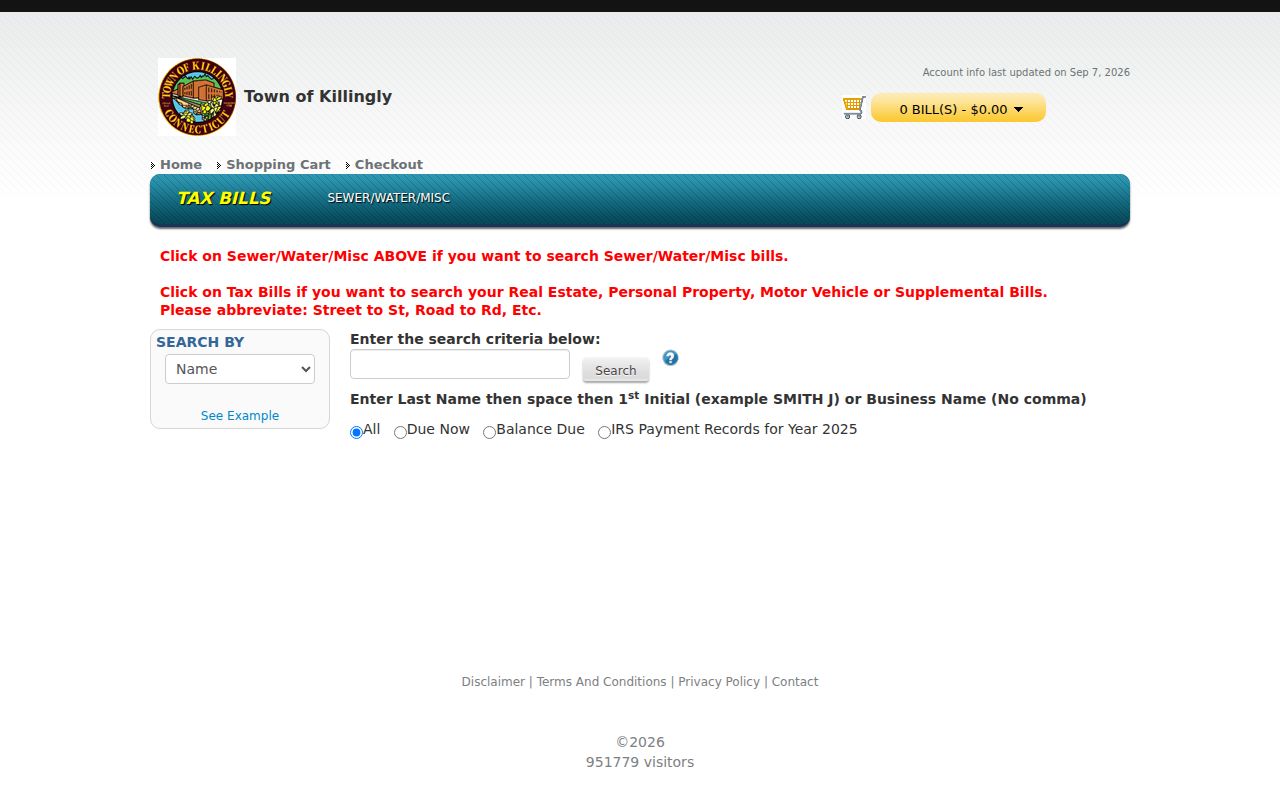
The Killingly MyTaxBill portal accepts many search keys. Name, property address, bill year and number, account number, Tax ID, Account ID, DBA, and link identifiers all work. Its controls cover Killingly only. Other Windham County towns keep separate systems.
Format matters here. Name search takes a last name, a space, and a first initial, with no comma. Address search uses the property number and street name.
| Search route | Input | Verify |
|---|---|---|
| Name | Surname and first initial | Correct parcel and bill type |
| Address | Number and street | Real-estate account |
| Bill | Year, type, number | Installments and balance |
| Account or Tax ID | Exact identifier | District and owner display |
The system also carries personal-property, vehicle, sewer, landfill, and district bill types. Read the label on each result rather than assuming every match is real estate.
Windham Tax Payments May Post After the Transaction
The Windham Revenue Office publishes bill timing, rates, payment channels, and convenience fees. Its notice warns that online payments may take two to four business days to appear. Fee amounts and timing can change. Save your confirmation. Then check the account after that interval.
For a payoff or closing, contact the collector for a current figure. Under CGS §12-144b, the oldest obligation can be applied first in the described circumstances. When the balance looks off, ask how the payment was allocated.
Exemptions and PA 490 Start with the Assessor
Windham treats exemptions and programs as assessor work. Connecticut provisions may cover eligible veterans, older or disabled owners, and qualifying farm, forest, or open-space land under PA 490. Forms, proof, deadlines, and renewal rules call for a current town check. Read the parcel card for a program flag. Then ask the assessor for the current form. An exemption changes taxable treatment, not ownership or the underlying assessed value. A missing public flag says nothing about private eligibility.
Delinquency and Tax Sale Status Need a Live Check
A collector account may show a balance, interest, demand, or payment history. Windham describes its delinquency process and statutory tax-sale authority. A portal may lag behind a same-day payment. It may also miss certain legal costs, or omit a newly filed release. For purchase due diligence, ask the collector for current status. Search the town clerk for recorded tax liens and releases. Court enforcement may create a Connecticut Judicial Branch civil case. The online docket is a lead, not the official case file.
The 2026 Windham Property Tax Notice Is Dated
The 2026 notice lists bills mailed June 30, 2026, due July 1, with August 3 as the last no-penalty date. It also states district and motor-vehicle rates. Those facts are time-sensitive. Reusing them for another cycle without the live office page invites error.
Note: Whenever a tax result may matter later, write down the notice year, the district, the due date, and the date you checked. Keep that note with the parcel number.
That habit keeps an archived bill from being mistaken for the current account. It also makes district comparisons far more reliable.
Offline Tax and Assessment Access Remains Important
Some parcels simply will not appear in an online search. When that happens, take the legal town, situs address, owner spelling, and any parcel or map-lot clue straight to the town assessor. Ask to see the public card. Ask also for the assessment year, the revaluation date, and an explanation of any program or district field on the account. Balances and liens are different work. A payment allocation, lien question, or tax-sale status belongs with the collector, since the assessor cannot interpret another office's account.
Windham County property tax records stay available through town channels even without a public web search. Mail, email, counter, and certification practices differ from town to town. Connecticut FOIA requests must go to the agency holding the records, and statutory land-record charges can apply to recorded liens and releases. Tax figures change, so keep the response date.
Tax Records Corroborate a Parcel but Do Not Convey It
A tax bill is a useful cross-check. Its owner display can confirm that an assessor result and a GIS map refer to the same parcel. So can its district. It is not a deed, however. A tax record is an administrative account, so it cannot convey title. An ownership dispute turns on the newest recorded instrument and its legal description. Mapped boundaries call for the recorded plat and qualified survey evidence.
Timing matters most after a closing. The clerk's recording timestamp can change at one moment. The assessor update and the collector mailing name can each change at a different one. Keep all three rather than trusting the newest screen unchecked.
Contest a Windham Assessment on the Current Calendar
Start with the assessor. Ask that office to verify the parcel facts, building data, and acreage. Also confirm the assessment year and exemption treatment before anything else. A February 20, 2024 deadline applied to the 2023 cycle. That date is historical now. Current informal-hearing and Board of Assessment Appeals instructions come directly from the town.
Good support includes comparable sales, photographs, measurements, and a list of record errors. The assessor explains or corrects the mass-appraisal record. The Board of Assessment Appeals provides the formal local route. Assessed, market, and sale figures differ. For that difference, see the Windham County property value guide.
Appeal window. Filing dates vary by town and cycle. Confirm the current deadline with the assessor or Board of Assessment Appeals.
A complete Windham County property tax records note has a checklist. Record the town, real-estate account, situs, parcel ID, and owner label. Add the grand-list or assessment year, revaluation date, taxing district, and installment. Note the posting date, balance, and date checked too. Preserve the source for each number. The assessor builds the assessment record. The collector maintains the bill and payment account. A recorded lien or release question needs a town-clerk filing.
When figures conflict, compare like dates first. A 2023 revaluation base can be valid. So can a later assessment update. So can a July bill, and a payment posted days afterward. Ask the right office to explain its own field. For an appeal, keep the notice, filing date, town form, supporting sales or appraisal material, and the board decision. A portal balance or assessor card alone does not preserve that procedural record. Keep the dated town response.