
Recognize the Deeds in Windham County Deed Records
Telling a true conveyance apart from an encumbrance or a notice is the first skill. A document inventory built from the record types themselves gives you a reliable checklist for reading results. Trust the label printed on the instrument.
| Deed Type | What It Does | Common Use |
|---|---|---|
| Warranty deed | Conveys the stated interest with covenants | Ordinary sale transfer |
| Quitclaim deed | Conveys whatever interest the grantor has | Interest cleanup or family transfer |
| Fiduciary deed | Conveyance by an executor, administrator, or trustee | Estate or trust transaction |
| Correction deed | Corrects a prior recorded instrument | Name or description correction |
| Certificate of foreclosure | Records the result of a foreclosure process | Court-linked title event |
A mortgage only secures an obligation. A lien asserts a recorded claim. Neither one, by itself, transfers ownership, and releases or satisfactions later close those entries. Read the deed image, the legal description, and any prior-instrument reference before drawing conclusions about title from a result label alone.
Each Town Clerk, Not Windham County, Records Deeds
Connecticut dissolved county government in 1960. That single fact shapes every Windham County property search. What people call Windham County deed records are really separate systems. There are 15 town record systems, each with its own clerk. The Windham Town Clerk, at 979 Main Street in Willimantic, records land for Windham and Willimantic. That office also offers SearchIQS. A deed for Killingly, Plainfield, Putnam, or Woodstock belongs with that town's own clerk instead.
When the portal misses a year or a document type, contact the custodian directly. Give the town, party names, date range, address, instrument number, or book and page. In-person indexes, maps, films, and vault books still matter. A Connecticut FOIA request goes to the actual custodian. Statutory land-record fees still govern copies and certifications.
SearchIQS Fields Narrow Windham Deed Records
The SearchIQS historical index-book guide describes the separate route to follow when modern search fields no longer reach the deed you need.
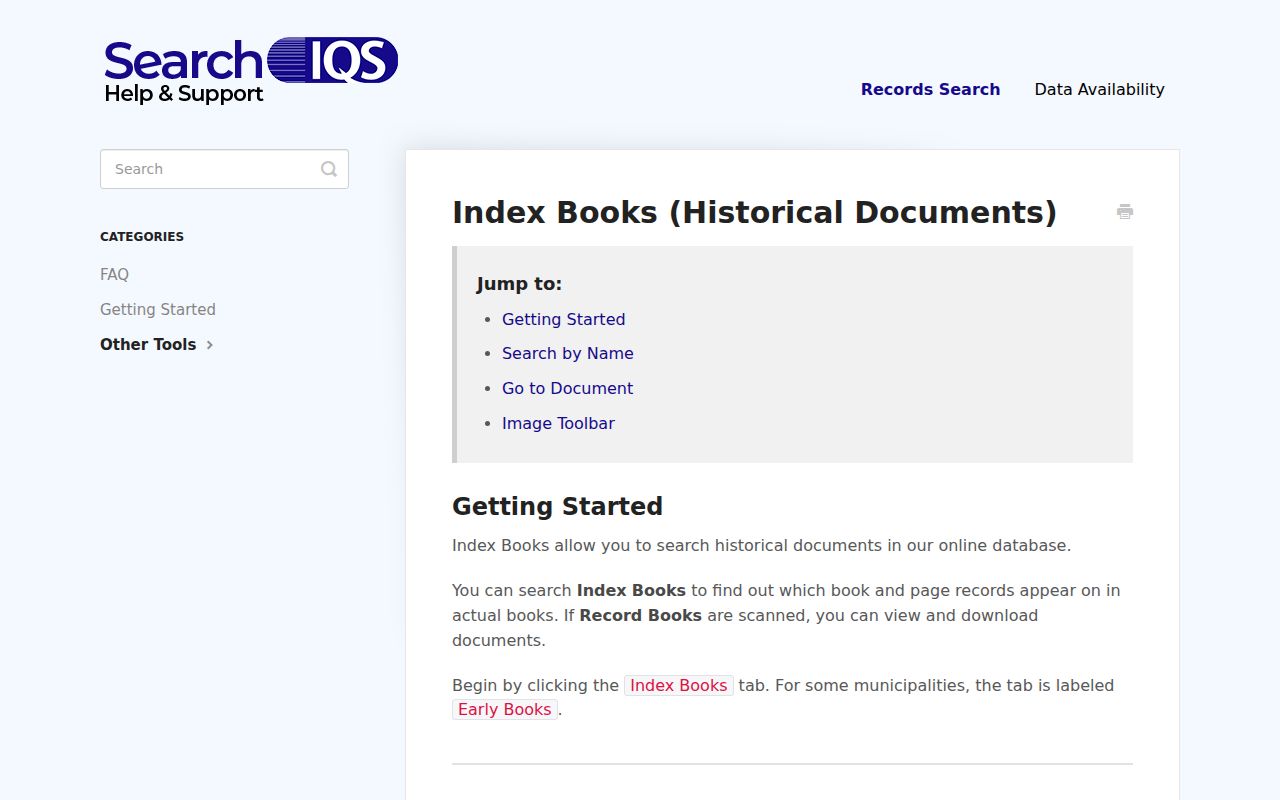
The guide also shows why an index-book image has to be followed through its book-and-page workflow. The Windham SearchIQS portal allows guest access. Its help screens explain Party 1 and Party 2, optional dates, document group and description, town where available, book and page, instrument number, and case number. Type individual names with the last name first. Save the wildcard for testing a partial spelling.
| Control | Use in a deed search | Caution |
|---|---|---|
| Party 1 / Party 2 | Test both sides of a transfer | Role treatment can vary |
| Date From / Thru | Narrow recording dates | Execution date may differ |
| Document description | Separate deed, lien, release, or map | Local labels require live review |
| Book/Page | Open a known reference | Older volume coverage varies |
| Instrument number | Retrieve a modern filing | Copy it exactly |
Fewer criteria cast a wider net. Run a broad name search first, then filter by date and document type, because an overfilled form can bury a valid spelling variant.
Walk the Windham Grantor-Grantee Chain
Start with the newest recorded deed for the exact parcel. Transcribe every link before stepping backward through the chain. Compare legal descriptions and map references as you go, since the same name can surface in transactions that have nothing to do with your parcel.
- Find the current acquisition deed with the present owner as grantee.
- Record the grantor, date, type, instrument, book/page, and prior reference.
- Search that grantor as a grantee in the earlier acquisition.
- Repeat, switching to index books and book images at the modern cutoff.
- Grantor
- The party conveying the stated interest.
- Grantee
- The party receiving the stated interest.
- Chain of title
- The ordered sequence of instruments tied to the same land.
- Book/page and instrument number
- Different identifiers used to retrieve a recorded document.
The 1965 Cutover Changes a Windham Deed Search
Windham's availability table lists index data and images from November 24, 1965 forward. Grantor-grantee index books cover 1706 through 1977. Listed deed-book images run from August 3, 1687 through December 31, 1965. They span specified lettered and numbered volumes.
These layers overlap without being interchangeable. A phrase like online to 1687 describes book images, not a modern full-field search. For an early deed, pick an index volume and search the surname. Note the book and page. Then open that book image. If no image appears, ask the clerk about film or office access.
OCR Helps Find Windham Deeds but Does Not Control
The Windham Town Clerk cautions that optical character recognition can be inaccurate. The signed or printed town copy controls. OCR can still point you to a likely party or phrase. But old handwriting, faint pages, abbreviations, and damaged type can distort names, acreage, or covenant text.
Check the actual image. Look for grantor and grantee capacity, the legal description, easements, restrictions, acknowledgment, recording notation, and references. When a phrase affects a transaction, request a clearer or certified copy from the clerk. Do not trust extracted text alone.
Recorded Maps and Deeds Must Be Read Together
A deed often points beyond itself. It may cite a subdivision map, survey, lot line, road, easement, or older volume. Windham's current availability page lists map index data from January 1, 2012 forward. Earlier maps may call for clerk-office or archive research. GIS geometry helps with discovery but never replaces the recorded plat.
Write down the map number. Note the filing and approval dates, subdivision name, lots, roads, easements, amendments, and prior-map references. Then match those details against the deed's legal description. Treat a modern parcel ID as a crosswalk clue. It was not an identifier that existed when the early deed was written.
Estate Transfers Add Capacity Names to Deed Records
A tidy seller-to-buyer sequence can snap when land moves through an estate, trust, conservatorship, or court action. Search executor, administrator, trustee, conservator, and estate variants along with the decedent's own name. Probate districts also shifted over time.
The Plainfield-Killingly Probate District now serves Canterbury, Killingly, Plainfield, and Sterling, while older estates may route to historic districts, archives, or microfilm. Connect the probate authority to the recorded fiduciary deed. Neither record can stand in for the other.
Windham's Filing Alert Does Not Block a Deed
The Windham County clerk offers a free SearchIQS fraud-alert service that sends an email whenever a document is indexed to an enrolled name. It is a courtesy signal. The alert does not validate, reject, or block a filing. Shared names and spelling variants can also weaken the matching.
When an unfamiliar Windham filing arrives, open the image itself. Compare it against the parcel and the named parties. Then contact the clerk through an official number. Ignore unsolicited offers promising guaranteed deed protection. Monitoring earns its keep only when alerts get reviewed against the authoritative land record.
Deed Notes Should Preserve Retrieval Details
For every Windham County deed you handle, capture the details that lead back to it. Log the legal town. Note the parties and their capacities. Record the document type, plus the execution and recording dates. Add the instrument number, book and page, and image page count. Include the legal description, the map reference, and the prior instrument. Say whether you worked from an online image. Note if it came from office film, a vault book, a plain copy, or a certified copy. That compact inventory keeps later chain work reproducible. It also flags a missing link before anyone mistakes it for a transfer.
Request a Windham Deed Copy from the Custodian
Working research goes fastest with an online image. Need a plain or certified copy of a Windham County deed? Contact the recording town directly. Give the clerk the instrument number or book and page. Also give the parties, the recording date, and the document type. Windham towns also allow in-office land-record research, with pre-1966 films and index books available.
CGS §7-34a governs recording fees. Copy charges and clerk schedules should be confirmed before any payment. Connecticut towns post current figures on their schedules. The local clerk remains the source for the exact amount and the accepted request channel. Mail, email, portal, and counter practices vary across the 15 towns.
Recorded, not guaranteed. Windham County deed records show filed instruments. They are not a title opinion, and unrecorded interests or indexing errors may exist.
Before closing a Windham County deed records search, reconcile every transfer against the same land. Names and dates alone will not carry that weight. Compare the legal description, acreage, map or lot references, and easements. Check the prior instrument too. Look closely at the capacity in which each party signed, since a trustee, executor, administrator, conservator, or company signer can change a name without breaking the parcel trail. Corrections, confirmations, releases, and foreclosure certificates belong in your notes apart from the deeds themselves.
Keep a gap log for missing volumes or images. Record the town, index volume, surname range, book and page, and stated coverage. Save the exact response from SearchIQS or the clerk. Then ask whether the item exists on film, in a vault book, by mail, or during an office visit. This habit keeps an unavailable scan from being misreported as a missing conveyance. It also gives the town clerk enough detail to retrieve the Windham deed.